For more than a decade, Shaun Brown has been building tech tools inside the House, first for Democratic leadership staff and then with House Digital Service. He shares responsibility for building innovative apps like DomeWatch and LegiDex.
Recently, he launched a new external product called Apogee to apply AI agents and algorithms to connect disparate streams of official legislative branch, federal election, and lobbyist disclosure data into more than 60 specific capabilities for advocates, nonprofits, policy wonks, and congressional staff.
Instead of dashboards or search commands featured in legacy legislative tracking and intelligence services to access public data in a gated environment, Apogee pairs with leading agentic AI platforms to allow users to ask questions that release agents to find information within official datasets. Asking “tell me everything about this bill” returns not only congressional action, but information on hearings, lobbying activity, news coverage, and advocacy groups’ positions. Agents can be set to watch topics as legislation advances or Congress takes up specific issues and provide users with updates automatically.
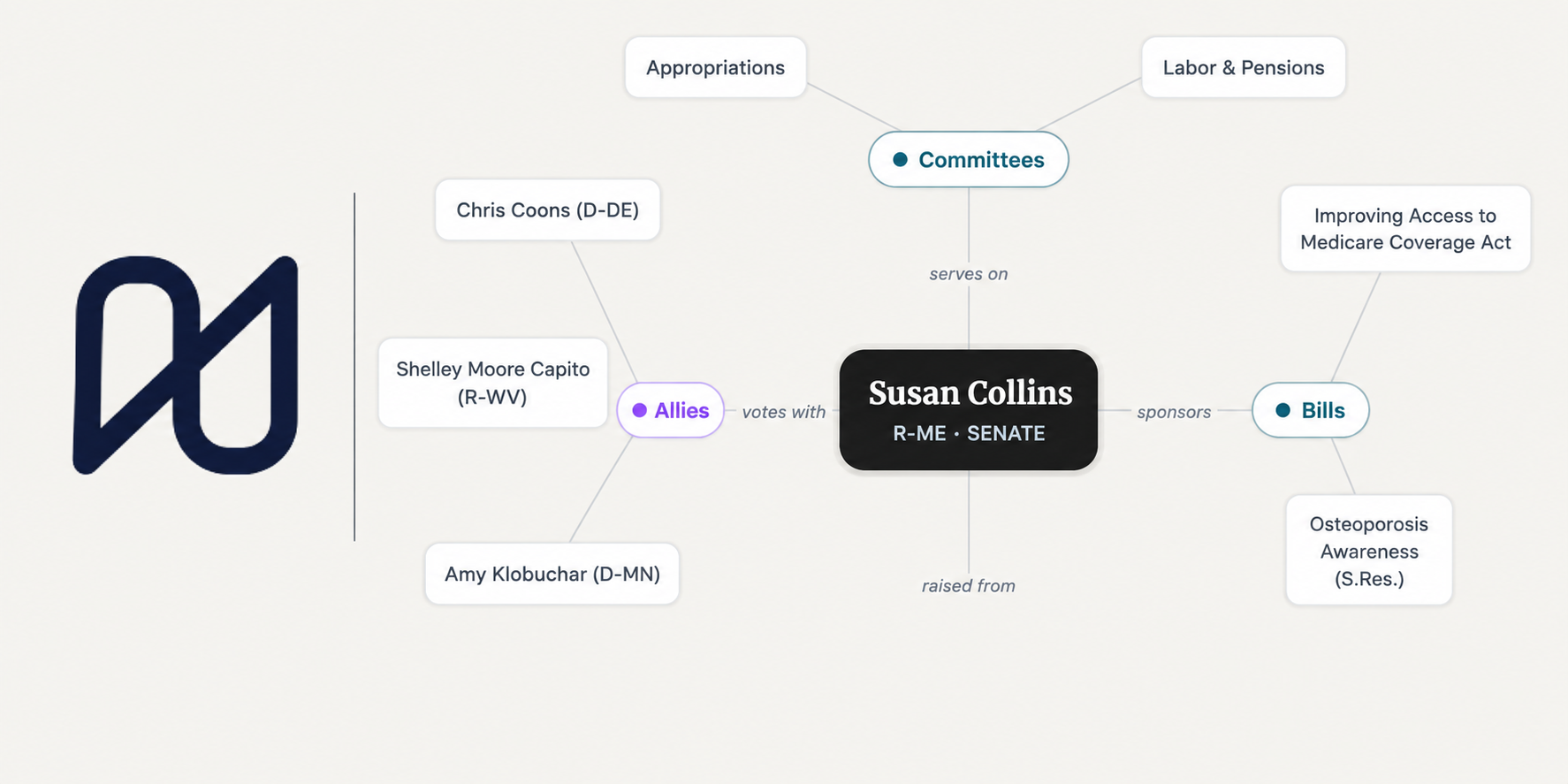
Apogee also generates knowledge graphs that can identify members’ political networks and influence, voting blocs and potential unusual voting alliances, interest group influence, and bill similarity, among other capabilities.
Brown sees AI’s role in dramatically reducing the difficulty in accessing and using public datasets to generate clear awareness of what’s happening in federal policy (he’s also building out state-level capacity). Applying existing AI models to official data from a variety of sources essentially levels the playing field for those working outside of well-resourced advocacy shops by producing reliable deliverables quickly and cheaply. Its cheapest plan starts at $29 a month, which fits neatly in member office tech budgets.
The value for congressional staff, Brown told me, is in the ability to generate the standard short reports, backgrounders, and one-pagers quickly and with information pulled directly from sources that can be verified by staff for accuracy. Its ability to track issues as well as members’ positions and legislative activity over time, meanwhile, can solve for some of the institutional memory challenges in member offices given high staff turnover.
Much of what Brown has done with Apogee could be built by Congress using its own data. House Clerk and Library of Congress staff discussed the potential of using semantic search to make Congress.gov more user-friendly in a recent CHA Modernization & Innovation Subcommittee hearing, so ideas are circulating within the legislative branch. For now, those on the outside continue to fill the gaps.