In previous years, the Congressional Hackathon acted as the third quarterly meeting of the Congressional Data Coalition. The House decided not to host that event this year and is moving it to an every-other-year schedule. As a result, the September 2026 meeting took place online. The full video of the event is available on the Government Publishing Office’s Legislative Branch Innovation Hub.
The meeting provided demonstrations of the latest version of the House Clerk’s Comparative Print Suite (1:51:48 in the meeting video) and of the Congressional Research Service’s Text Analysis Project (1:40:00 in the meeting video), two innovative, AI-powered tools developed specifically for congressional users. Together, these tools can track how legislative language travels across bills – how particular language is incorporated into various bills and how it is reintroduced in multiple Congresses – and provide deep analysis into how amendments would change bills and bills would change the law. Knowledge is power, and timely knowledge empowers legislators to know what they’re voting on and be able to advance their own proposals. These tools are major success stories for legislative branch technological development. The limits on their availability also provide a window into the policy choices made regarding who they empower and the politics they must navigate.
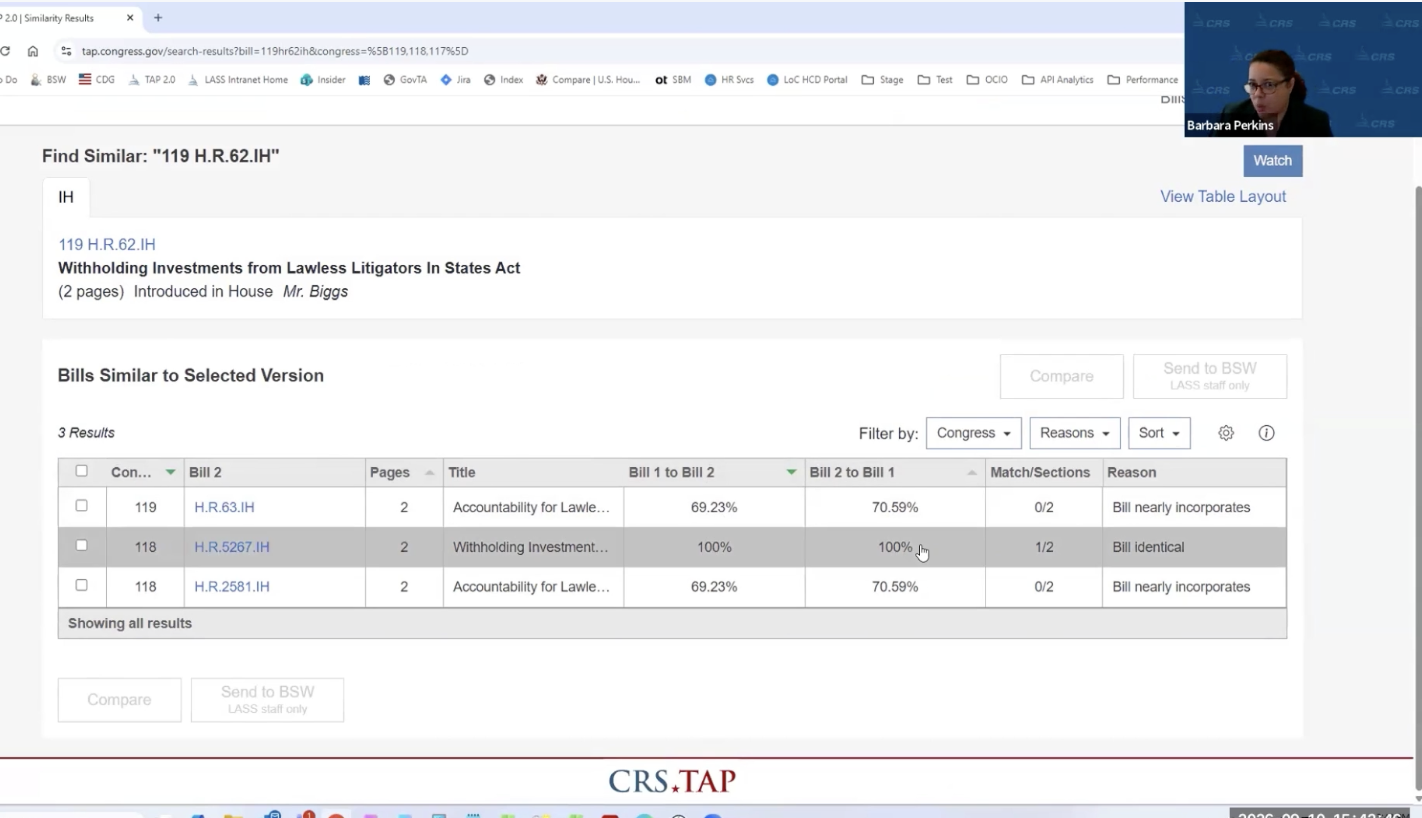
Both of these tools were developed for particular legislative branch users and purposes. The Comparative Print Suite is a collaboration between the House Office of Legislative Counsel and the Clerk’s Office to assist staff in the bill drafting process, pushed forward by the late Rep. Bill Posey, who wanted to understand how the text of legislation changed between drafts. TAP helps CRS produce bill summaries by giving analysts context and allowing them to find the correct versions of introduced bills that have been sucked up into large legislative packages.
One thing TAP has enabled that does reach public users is new related bill tracking functionality on Congress.gov. Users can access a “Related Bills” tab when pulling up the page for a specific piece of legislation. The tab lists records including a link to related bills, their sponsor, title, specific relationship, and latest action. The update includes a note and link when a bill was incorporated into a larger piece of legislation.
Users also can track related bills introduced by specific members under the “Member Activity” section of their individual page in Congress.gov, including legislation members have reintroduced from a previous Congress. Going through the route of member pages addresses a recommendation of the House Select Committee on the Modernization of Congress, which called for creating ways that allow members to take credit for legislation that they authored, but for various reasons were enacted in a different legislative vehicle.
The Library of Congress also has launched a beta version of slip law and enrolled bill text in USLM format on Congress.gov. In the past, Kimberly Ferguson said at the meeting, some bills were too large to be able to be displayed in a web browser. The format update not only provides a machine-readable option for the interface but allows further readability benefits like in-text links for specific sections.
The Library also made several other additions to Congress.gov: a title type in its API field values that can accommodate short and long versions of bill titles, House roll call votes stretching back to 2017
Lobbyist disclosure: new meeting, same answer
The House and Senate have successfully created a unified search capacity across both chambers for the lobbyist disclosure website (LDA.gov) under development that allows public tracking of information submitted in lobbyist disclosure reports.
Four years into the project, however, we’re still waiting for unique identifiers for individual lobbyists so they can be tracked with precision. The Senate has been the lead on this project, and whatever decisions need to be made to move this feature along remain in the misty future.
More on the Data Map
Mark Caudill from the Government Publishing Office explained the functionality of the Legislative Branch Data Map, which is living on GPO’s innovation hub. It’s set up for different types of users, with links to the webpages that host different data sources and access to the raw DCAT metadata for those who want to repurpose the data. GPO also is accepting feedback and contributions through the GitHub for the project, so this is very much an open, growing project.
This project is a fun success story, starting off as an AGI project at the Congressional Data Coalition website, then becoming a joint project between CDC and the House Digital Service. Daniel Schuman and HDS’s Steven Dwyer demonstrated the first iteration of the data map at last year’s Congressional Hackathon. It’s now fully managed by the Congressional Data Task Force with buy-in from internal and external stakeholders.
Kirsten Gullickson from the Clerk’s Office added that her team worked this summer on developing subject matter terms in a controlled vocabulary to add to the data map at a later date, perhaps at the end of the year. It should aid navigating the resources available.
Congressional MPCs
Caudill also shared that the documentation for the GPO’s new MPC server is up on the office’s GitHub, which folks can use to point agents to the source of authoritative legislative branch data rather than bouncing around the web or making things up.
Forum participants asked several questions about other MPC opportunities, including whether the Library is developing one and how the House is thinking about providing structured data to AI vendors to use to train agents directly. These ideas clearly are being explored in the House from the answers provided, but it’s a question to ask the Library again during the upcoming forum. While providing data via MCP is useful, the emphasis should remain on making more congressional data publicly available, whether in bulk, via API, or through an MCP server.
From CAO
The Office of the CAO announced a new staff leave tool and AI programming for staff. The House Digital Service has started a pilot with 10 member offices to test a new staff leave and telework request system called LeaveTrack. HDS product manager Ananda Bhatia said the platform will allow staff to request time off and telework and see their time off accruals and office policies. It also will sync with Outlook so member offices can view who’s out of the office or working remotely conveniently.
The goal is the tool will make it much easier for staff to manage these back-office tasks, replacing bespoke spreadsheets or text documents.
CAO’s Stephen Dwyer highlighted a hands-on AI testing event through the House AI Center happening today and two open positions for the new office (more on that below). The AI Center also has launched its AI Innovators pipeline project that the Committee on House Administration announced recently, which will give tech-savvy staffers access to secure data sandboxes in which they can build and test new AI-powered tools for their offices. The project is limited right now, but is a major development for in-house (or in-House) modernization capacity.
From civil society
Dave Zvenyach returned to the CDTF to provide an update on AGI’s projects to improve the accessibility of appropriations data that is locked within committee reports and provide context on how appropriations report language changes over time.
The first project, on tracking appropriations spending over time, is challenging because the appropriations tables are challenging for a computer to ingest not only for their accounting-related formatting with numbers, but nested text that indicates to human readers specific programs under larger budget lines that make it difficult for computers to draw relational connections to structure data. We know this because we’ve had to build legislative branch appropriations datasets by hand.
The second project, on tracking changes in appropriations report language over time, makes it possible to see how report language has changed over the years.
Both projects make use of advanced AI capabilities, which Zvenyach has been experimenting with thanks to a grant AGI has received. OCR can take data out of the source PDFs, then Gemini Pro and Nemotron parse the data to give it usable structure. It’s working pretty well, with 46 out of 52 appropriations bill reports reaching a strong matching rate between what the agents generated and what’s on the PDF.
However, blindly relying on AI would be a serious mistake. It routinely makes serious mistakes. We have been benchmarking different AI tools to evaluate their analytical capabilities for legislative analysis as well as using them to assist with creating deterministic tools to perform the work. Dave called for others interested in this work to help us engage in quality assurance on the data derived from these efforts.
Daniel Schuman reiterated to the forum that this is an interim step in making past appropriations data machine-readable that we think should be available from official sources in the House and Senate. The Library of Congress helpfully noted that our work to make current and historical data available is complementary to their efforts to make certain sets of legislative data publicly available on a going-forward basis. We agree and would welcome the opportunity to share ideas, techniques, approaches, and work to close gaps in data availability.
Will Adler from the Bipartisan Policy Center demoed an open source legislative tracker that his team at BPC’s elections project built to help organizations track state and federal legislation. The goal of the tool is providing a collective way for legislative affairs teams to collaboratively track various bills, set team positions, and comment on progress without having to purchase expensive software licenses from vendors. From our perspective, this is a great way for organizations or organizational coalitions to track and share information on legislation that is of interest.
Called FloorVote, it pulls in LegiScan account data on introduced legislation across 50 states and Congress and uses AI to score bills for relevance to issue areas and other criteria that users can identify. Users can then set customizable filters to assist in legislative affairs workflows. The system also can set calendar notices for upcoming hearings on relevant topics and legislation.
BPC conceived of the tool to assist partner election law organizations in keeping track of legislative activity for no additional cost beyond LegiScan and Cloudflare accounts. This makes the tool affordable to just about everyone. Adler noted that user feedback and feature requests can be made on the FloorVote GitHub repository. Users can try a demo.
Luis Kimaid from Bússola Tech, a Brazilian think tank, invited meeting attendees to watch the proceedings from the sixth LegisTech Forum, which took place on September 22 through the 25th in Washington, DC. Bússola Tech, the American Governance Institute, the Organization of American States, and the House of Representatives co-hosted the event, bringing together parliamentarians, officers, and technologists from about 30 parliaments around the world to discuss how technology is transforming and challenging legislatures, with emphasis on how parliaments themselves are designing their own digital innovations.
AGI summarized the event in the First Branch Forecast and Bússola Tech has posted its own recap. Videos of past panels from previous events are available on the Bússola Tech website.
Odds & Ends
The Congressional Modernization Staff Association made its first official appearance at a task force meeting, although its presence is often felt because its founder and long-time president, Ananda Bhatia, has presented at many meetings. With Bhatia installed at the House Digital Service, she has passed the MSA leadership torch to Paul Hurton, a staffer with the Senate Homeland Security and Government Affairs Committee. In addition to introducing himself and the MSA, he noted the organization’s new Substack (more on that below). Membership is open to all congressional staff, including in support offices and agencies.
Secretary of the Senate webmaster Arin Shapiro previewed updates to the Senate website, which are now live. The goal of the update was to improve accessibility, including new “mega menus” to help users drill down into different sections of the site faster. The new site also will have an alert when the Senate is in session at the top and a link for the live video feed as well as a larger footer.