Author Archives: Daniel Schuman

Congress Press, a collection of congressional press releases

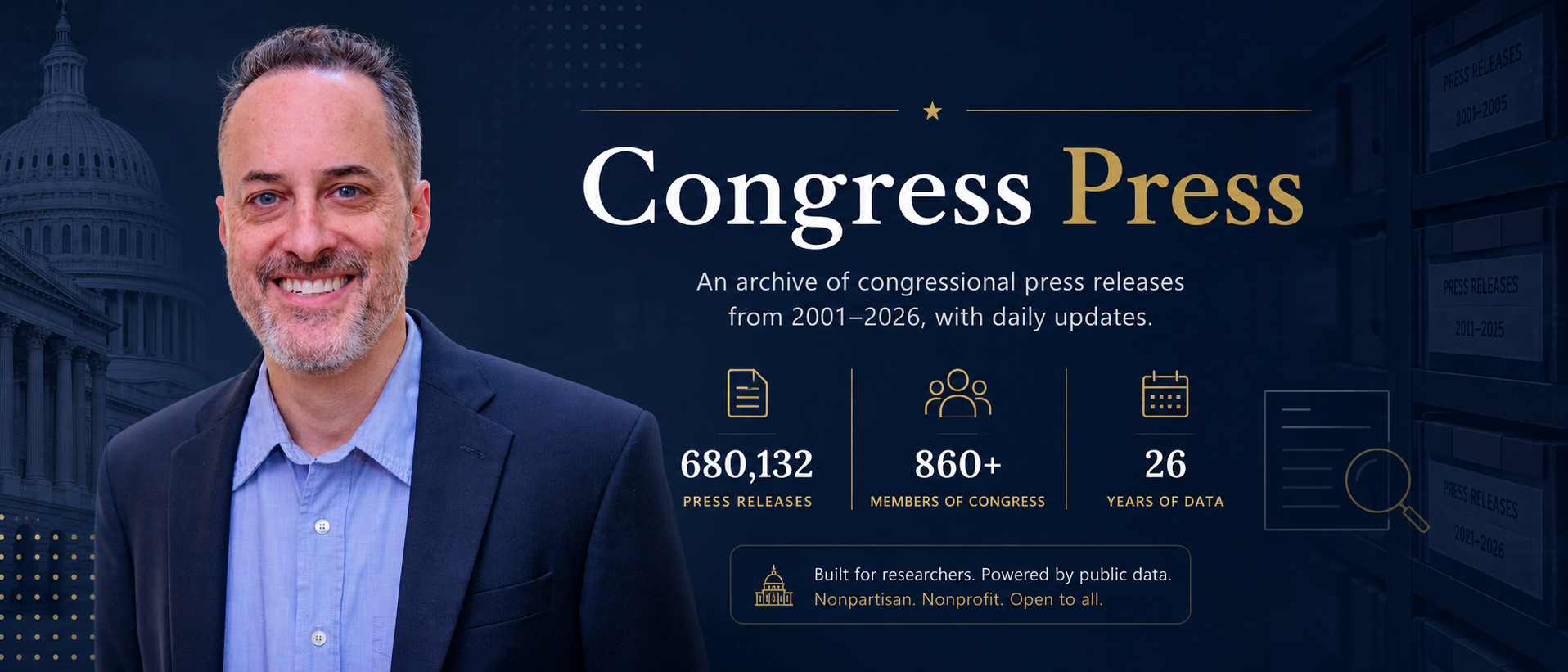
A combination of images of Derek Willis, creator of Congress Press, and information from his website about the number of press releases they have.

Our first featured project is from one of the legends in congressional data and data journalism, Derek Willis of the Merrill College of Journalism at the University of Maryland. This spring, he released Congress Press, a spiffy update of his efforts to collect and share congressional members’ press releases he first started at ProPublica.

Continue reading

Welcome to Maker Space, a new series on Congressional tools

An AI generated illustration of a maker space.

The community of people inside and outside Congress who are tinkering with different legislative datasets and code to produce useful tools is growing rapidly. It’s a sign of the success of efforts like the Congressional Data Task Force and Congressional Hackathon and open mindedness of stakeholders across the House and Senate to encourage experimentation. That community is still somewhat decentralized, though, so discovering new projects can be a challenge.

To that end, we’re starting a new semi-regular series to highlight individual projects large and small called Maker Space to build greater awareness of the cool stuff out there.

Continue reading
Congressional Hackathon Logo

Congressional Hackathon 7.0: Coding, Collaboration, and Culture Change on Constitution Day

The Congressional Hackathon that took place this past Constitution Day on September 17, 2025, is a rarity in today’s Washington. Civic minded citizens joined with congressional staff in a day-long discussion inside the U.S. Capitol on strengthening Congress by improving and democratizing its technology. More information from the event, including video and a report, will be published on the Legislative Branch Innovation Hub.

The bipartisan nature of these events is a recurring theme, with senior Republicans and Democrats always offering opening remarks and providing space and support inside Congress. Indeed, the Speaker broke news at the Hackathon, announcing the House would be distributing up to 6,000 user licenses to congressional staff to use Microsoft’s M365 Copilot AI-powered chatbot for a year.

This is the seventh such Congressional Hackathon, with the first organized back in 2011. This iteration also was the fourth annual event in a row. I’ve been to them all and this event brought forth a groundswell of energy. Some of it came from the new coding breakout session, where almost 90 participants built tools side-by-side with congressional staff that provide insight and services to people in Congress, across government, and around the country. It reminded me of the civil society-organized hackathons of the 2010s that had so much energy and potential. We all owe a debt of appreciation to Speaker Johnson, Democratic Leader Jeffries, and CAO Catherine Szpindor for co-hosting.

Continue reading

Legislative Branch Data Map

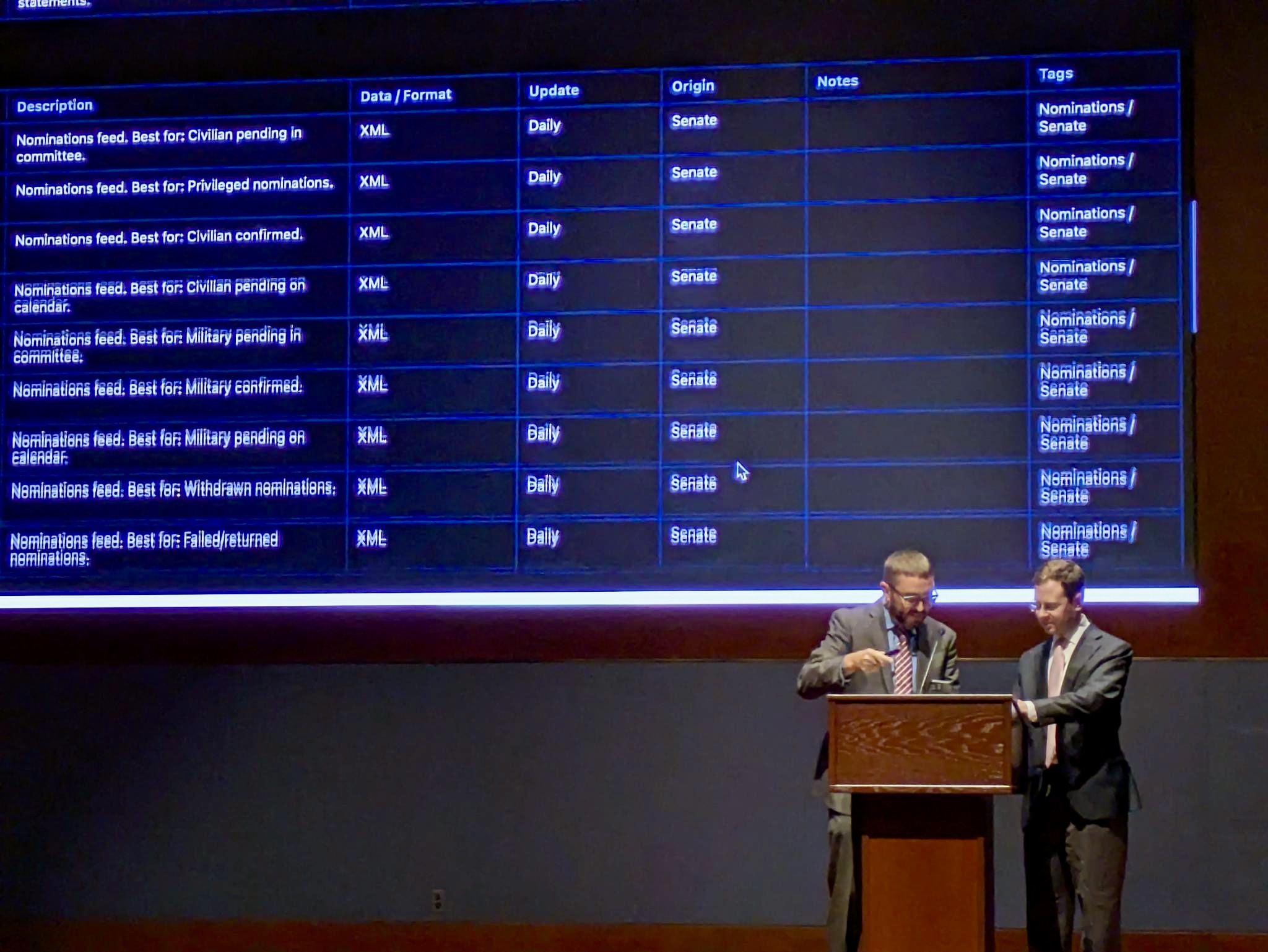
The House Digital Services Steve Dwyer and the Congressional Data Coalition's Daniel Schuman unveil version 0.1 of the Legislative Branch Data Map at the Congressional Hackathon 7.0 on September 17, 2025. Photo credit to Josh Tauberer.

One important project catalyzed by the 2025 Congressional Hackathon was the coming together of a Legislative branch data map, the existence of which had been requested by Appropriators. The map is an effort to identify across the Legislative branch the different sources for congressional data and drew rhetorical inspiration from the 2013 executive order on making open and machine readable the new default for government information, the 2018 Open Government Data Act, and advocacy from public-interest minded groups.

The map data was seeded from my 2023 biased yet reliable guide to sources of information and data about congress and collaborations from governmental members of the Congressional Data Task Force, although its GitHub repository quickly drew pull requests from hackathon participants as well. In other words, anyone can suggest items to add to the list of Legislative branch data sources and that list can point to official and non-official sources for data. The map improves the findability of information and makes it discoverable when someone has done the hard work to refine that information into a useful format.

Here is where you can find and suggest edits to the Legislative Branch Data Map, version 0.1.

Congressional Hackathon 7.0 announced for September 17

The Seventh Congressional Hackathon will take place on Wednesday, September 17th, from 1-6 pm in the CVC Auditorium at the U.S. Capitol. The non-partisan event was jointly announced by Speaker Johnson and Democratic Leader Jeffries and will be co-hosted by the House Chief Administrative Officer. The event is open to the public, and pre-registration is required. From the announcement:

Continue reading

Congressional Hackathon 6.0

Congressional Hackathon 6.0 took place on September 19, 2024 at the U.S. Capitol, co-hosted by Speaker Mike Johnson, Leader Hakeem Jeffries, and Chief Administrative Officer Catherine Szpindor. The event brought together congressional stakeholders to explore the role of digital platforms in the legislative process. After the event, organizers released video from the full proceedings as well as a highlights reel, and are expected to release a report summarizing the proceedings. You can find official resources on previous hackathons here.

Continue reading

Library of Congress Public Forum: September 8, 2024

The Library of Congress hosted a public discussion on Congress.gov on September 18, 2024, the fifth such forum it has held. You can watch video of the forum or read the Library of Congress’s summary of the discussion. We published a summary of prior forums from 2023, 2022, 2021, and 2020. They are held pursuant to direction from Congress, which required the Library of Congress to meet with the public concerning access to data from Congress.gov. More than fifty people attended in person and 400-500 people were expected to participate online.

Continue reading