It’s Time To Make Taxpayer-Funded Congressional Reports Available To The Public

This piece was originally published in the Daily Caller and co-authored by R Street Institute technology policy program director Zach Graves.

American taxpayers support the $140 million a year expenditures of the Congressional Research Service, an independent and highly influential think tank housed within the Library of Congress. The agency’s mission is to advise members and committees of Congress by providing objective, nonpartisan analysis. This typically includes explaining the workings of government agencies, the intricacies of complex policy issues in a range of disciplines and evaluating expensive, but often ineffective, government programs.

This research can be an invaluable resource for lawmakers and their staff, helping guide and inform key decisions in the policymaking process. At the same time, while taxpayers foot the bill, they are left out of the discussion, with no way to access this research short of calling their congressional office to ask for copies of each report.

This makes no sense. Most other government agencies can and do release their research. There is no reason the more than 1,200 new “general-distribution products” generated each year by CRS cannot also be made public.

That’s why we’re launching EveryCRSReport.com, a project to make all nonconfidential CRS reports available in one place for free (after all, you’ve already paid for it). The project is led by the Congressional Data Coalition, a cross-partisan partnership to promote open legislative information, whose members include Americans for Tax Reform, Demand Progress, the Sunlight Foundation and the R Street Institute. The site will grant the public access to more than 8,000 reports and report updates in one searchable database (it does not include confidential memoranda or private correspondence).

We don’t want to be in the business of hosting government reports. In the digital age, the government itself could and should be doing it. Legislation has been introduced in both chambers of Congress by a bipartisan group of members – led by Reps. Leonard Lance, R-N.J., and Mike Quigley, D-Ill., and Sens. John McCain, R-Ariz., and Patrick Leahy, D-Vt. – that calls for CRS to publish these reports officially through the website govinfo.gov. However, the bill still needs greater public support and awareness to overcome stubborn and spurious opposition from high-ranking members, such as Reps. Debbie Wasserman Schultz, D-Fla., and Tom Graves, R-Ga., who prefer to go about business as usual without inviting public scrutiny.

CRS was founded in 1914 as the Legislative Reference Service and originally adopted a policy of not making its reports publicly available due to concerns about the excessive cost to print and distribute them. This was justifiable at the time, since it was not the agency’s primary mission to serve the general public and, logistically, it would have led to unnecessary costs. In the digital age, this issue no longer exists. The Congressional Budget Office, which produces research on economic and budget issues and produces estimates of legislation, freely releases its work to the public online. So, too, does the Government Accountability Office, which investigates and audits government agencies and practices.

That’s not to say that CRS research is completely unavailable to the public. Congressional offices are free to distribute reports to curious constituents or other individuals on request. Thousands of reports can be found by a cursory Google search. Lobbyists and other D.C. insiders also can access the reports through expensive subscription services.

There’s no classified information in any of the reports on EveryCRSReport.com whose release could cause any harm. There should also be no concern that publishing would violate the privacy of report authors; the contact information of CRS analysts is redacted from the reports on our site. Regardless, other government agencies freely list authors’ contact information with their research, so this concern holds little merit.

The American public deserves to know what Congress knows. This ought not be a polarizing or partisan claim. It’s simply a matter of bringing government into the 21st century. There is broad support for making CRS research public. Groups on the left and the right, journalists, scholars, students, members of Congress and even former CRS employees all have supported public access to these reports. It’s time for Congress to be accountable to taxpayers and make this research public.

http://dailycaller.com/2016/10/20/its-time-to-make-taxpayer-funded-congressional-reports-available-to-the-public/
House launches a public-facing phone directory for all staff

As promised at the 2016 Legislative Data and Transparency Conference, the House of Representatives launched a public-facing phone directory for all its staff.

This is a tremendously useful tool. It provides authentic, up-to-date information on the people who work in the people’s house. While it (reasonably) does not contain email addresses, it has phone numbers, titles, and lots of other useful information about staff. It also will empower future analyses around employment in the House of Representatives, including discussions of legislative capacity and staff retention.

Until now, this information was only available through private vendors–for a fee–so the launch of the phone book amounts to a democratization of information about our elected representatives.

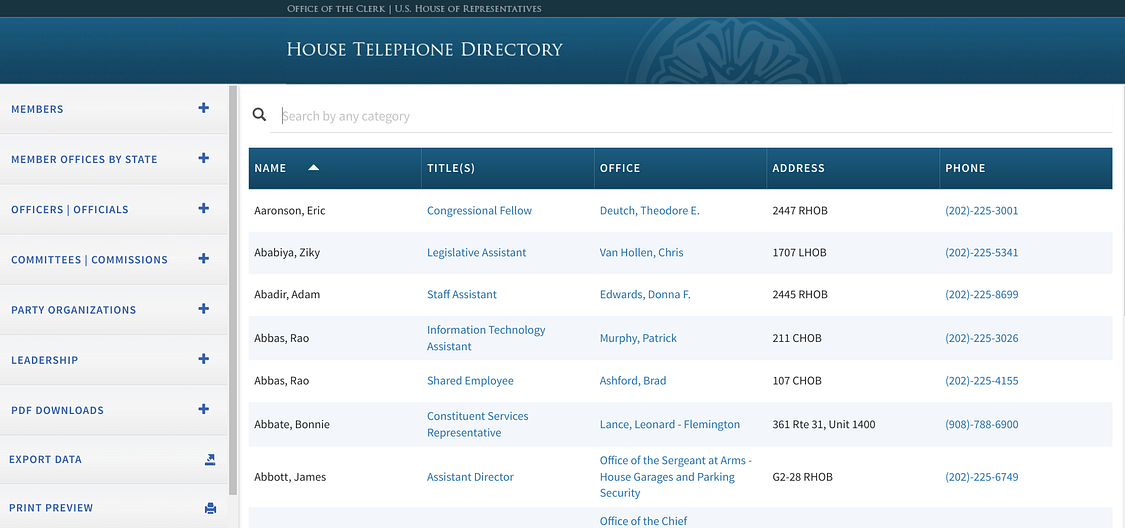
Using responsive design, so that it works on mobile devices, the phone directory allows anyone to obtain phone numbers and address information for any House staffer via a cleverly-designed interface. You can sort by member office, committee, or search for a particular staffer.

A screenshot of the new telephone directory website.

It’s also possible to download the underlying data set, whether as a CSV or PDF. This may save the House money on printing directories and provide more up-to-date information, particularly as staff move around all the time. The website was built by the Clerk and is extensible, so it may become possible to include the staff issue areas at a future date.

The Constitution (Annotated) In Your Pocket

After a powerful speech by Khizr Khan at the Democratic National Convention, sales of pocket U.S. Constitutions have skyrocketed, becoming the second best selling book on Amazon. This is great! But the words of the Constitution are unsufficient to provide an understanding into how it has been applied by the courts over the last two centuries. That’s where the Constitution Annotated comes it.

The Constitution Annotated (aka CONAN) is a plain language explanation of the U.S. Constitution as interpreted by the U.S. Supreme Court. Published by the non-partisan Congressional Research Service at the direction of Congress, CONAN provides insight into the meaning of our founding document. It also is available online as of 2013 and can downloaded as an app for your phone (iPhone) (Android is under development).

Unfortunately, there are flaws with CONAN — not the content, but how it’s made available to you. First, CONAN is published as PDF files, which makes it all but unreadable on your phone. The app is virtually worthless. Blast. Second, while CONAN is continuously updated by the folks at CRS, what’s available on the website and the app is not. Information can be a year or more behind recent court opinions. This is a travesty, especially when the information is readily available on the congressional intranet and the document is prepared in a format that allows for immediate updates.

We’ve been trying to fix this problem. Believe me. I’ve written about this at least once a year for eight years (2009, 2010, 2011, 2012, 2013, 2014), usually on my birthday, Constitution Day. And I’ve lobbied on it. We did finally get CONAN published online, after an enormous effort which resulted in this letter from the Senate Rules Committee to the Government Publishing Office. But CONAN still is not being published online as it is updated, and it’s still not published in a format that would support an app or sophisticated website.

As a result, people are reading highly-biased interpretations of the Constitution instead of the legal treatise that by law must be evenhanded and impartial, and is paid for by your tax dollars.

Maybe the Senate Rules Committee, the Government Publishing Office, and the Library of Congress will move to make the Constitution Annotated available online, in real time, and in a format that human and computers can use. At a moment with so many people are interested in the Constitution, Congress should make sure that everyone has access, electronically and otherwise.

Report from the 2016 Legislative Data & Transparency Conference

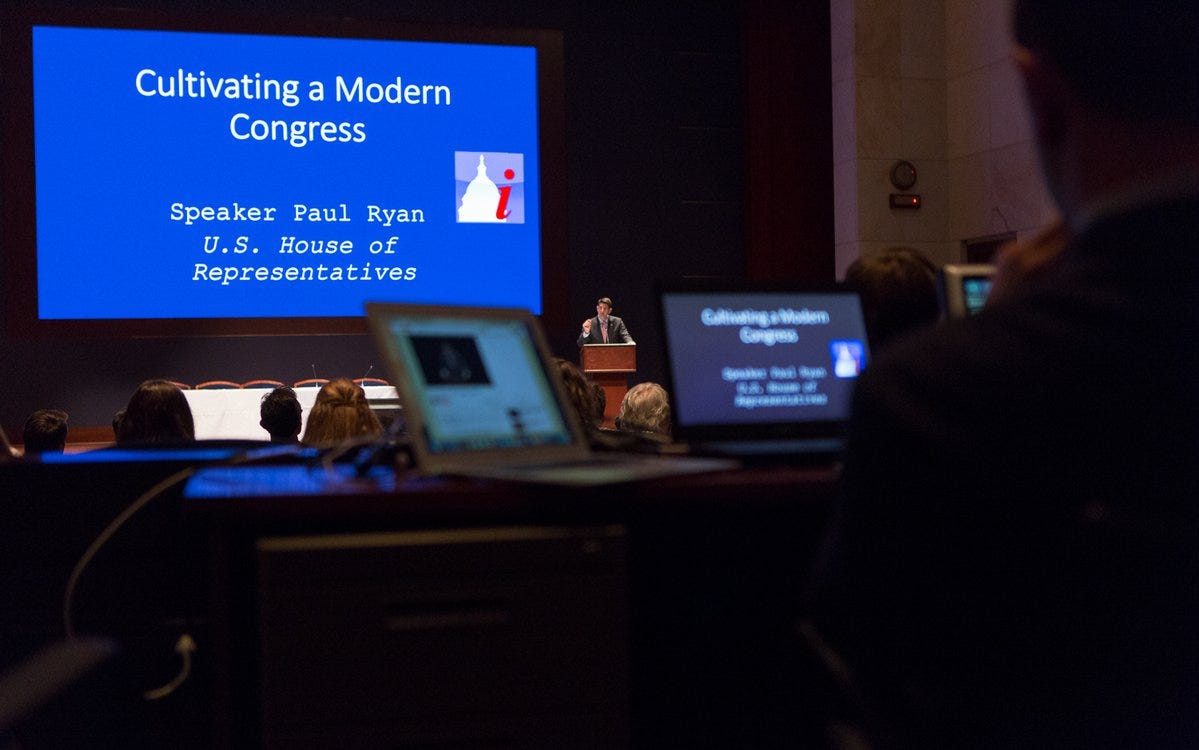
Today the House of Representatives’ Committee on House Administration hosted its fifth annual Legislative Data & Transparency Conference in the U.S. Capitol. The Conference brought together staff from House and Senate and legislative support offices, civil society advocates, technologists, overseas legislatures, and featured a speech by House Speaker Paul Ryan. More than 150 people attended, with more participating online.

There’s too much to recap from the conference — my notes, taken in real-time, are online, as is a video of the proceedings — but this blogpost will focus on the highlights. Once again, the most important aspect of the conference was that it brought together all the internal and external stakeholders to work together, announce progress, celebrate advances, and educate one another. It was a tremendous success.

Speaker Ryan: New Digitization Project

Speaker Ryan addressing the conference. Photo credit: Speaker Ryan’s office.

Speaker Paul Ryan announced a new project to publish enrolled legislation as structured data (in United States Legislative Markup Language). The project encompasses all enrolled bills (the final copies of legislation passed identically by both Houses of Congress), public laws, and statutes at large. In its first phase, all enrolled bills from the 113th Congress forward (i.e. January 2013 forward) and all statutes at large from the 108th Congress forward (January 2003 forward) will be published online in the same structured data format in which the U.S. Code is published.

While this sounds technical, what it does it allow the Congress to begin using more sophisticated tools to manage its legislation, including how it is written and updated. It becomes possible to tell better stories around what has happened with bills enacted into law, including formatting the laws so that one can see how they have changed over time.

It is expected that ultimately all legislation enacted by Congress will become available as structured data. Because much of the federal law is non-codified, this will make it easier to show how the law has evolved over time and reflect the current state of the law at any given time.

In addition to the technical details, Speaker Ryan’s announcement underscored the House’s continued dedication to making important information about legislative activities available online and in formats that support analysis and reuse. It is a doubling-down on the commitment made at the beginning of the Congress, in the House Rules package, to ensure that legislative information is available to the public in structured data formats — to support improving congressional processes and public insight into congressional action.

The Congressional Data Coalition had asked for this improvement, and some member offices have been requesting these changes as well.

Steady Improvements and a New Project from the Bulk Data Task Force

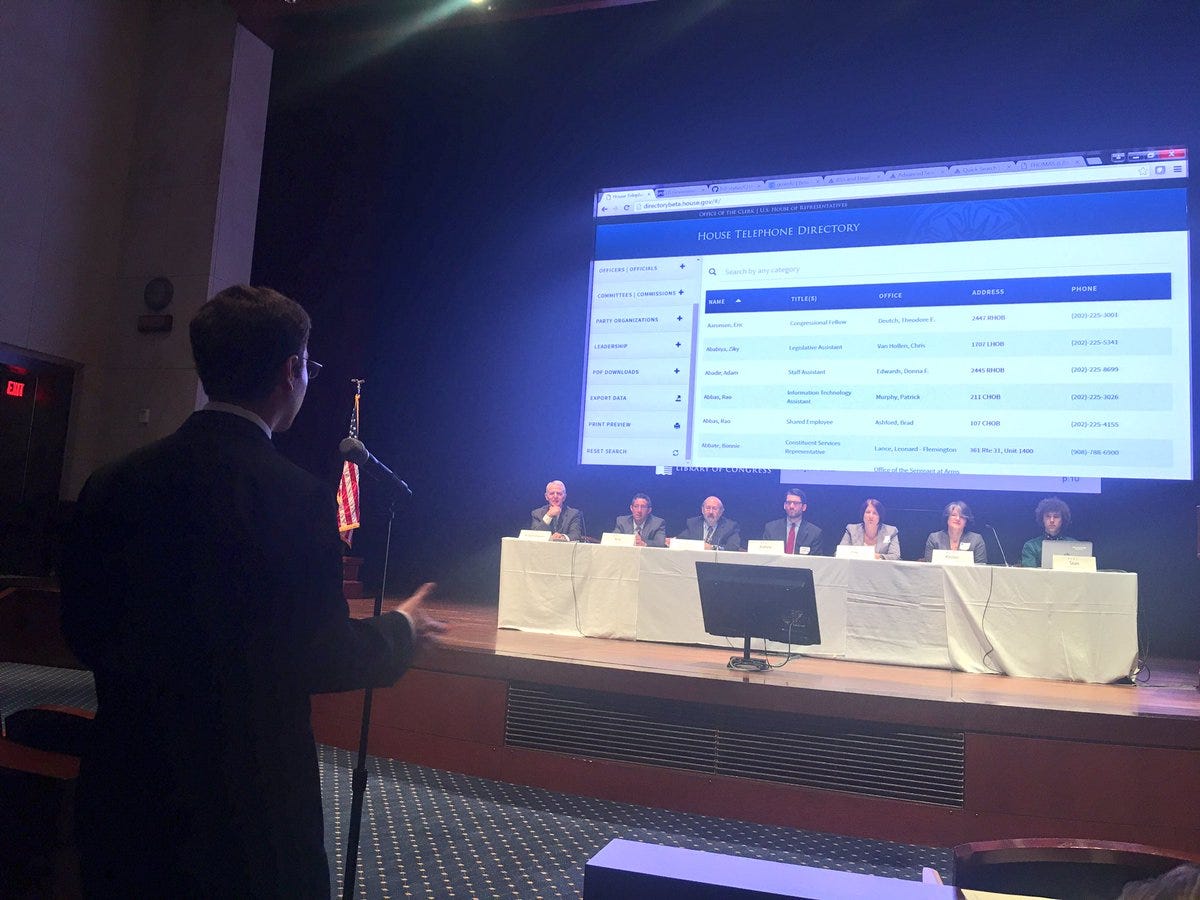
The Bulk Data Task Force Presentation. Photo Credit: Alex Howard

Phone Directory. The House of Representatives has built and will release to the public in August an online telephone directory. Using responsive design, so that it works on mobile devices, the phone directory allows anyone to obtain phone numbers and address information for any House staffer via a cleverly-designed interface. You can sort by member office, committee, or search for a particular staffer.

A screenshot of the new telephone directory website.

It’s also possible to download the underlying data set, whether as a CSV or PDF. This may save the House money on printing directories and provide more up-to-date information, particularly as staff move around all the time. The website was built by the Clerk and is extensible, so it may become possible to include the staff issue areas at a future date.

Congress.gov Data Updates. In response to public requests, the bulk data behind Congress.gov will be updated every four hours so that users can download the most recent data. Coming soon will be an RSS feed that will tell users when the data has been updated, so users known when to run their update processes. This is a change from the once-a-day update, which was discussed at the last Bulk Data Task Force meeting and had created problems for some users. The data updates will also be reflected on the GitHub page so that programmatic users will know specifically which data has changed.

Congress.gov Interface Updates. Congress.gov now has legislative alerts and other new tools (including improving command line and other searches). On July 5th, THOMAS will be retired after 21 1/2 years of service.

Office of Law Revision Counsel. The OLRC had 4 significant updatesbuilding on work from last year.

First, it will expand information about non-positive law that’s made available to the public to include XML format, not just PDFs.

Second, the development of Ramseyers — to track changes for legislation reported out of committee — is proceeding and it is expected to be used as part of the legislative process. This goes hand in hand with the Amendment Impact Program, which eventually will be publicly available and will make it possible to see how amendments change bills and bills would change laws in real time.

Third, the legislative lookup and link tool, which provides contextual information about references inside legislation, will become a public tool that everyone can look up on a public website.

Fourth, the OLRC is developing with leg counsel a new/updated legislative markup language to encompass new uses and data types. This is a second generation legislative markup language, of which the first was the Bill DTDs, and will empower many more ways to make sense out of legislative language.

And Still More

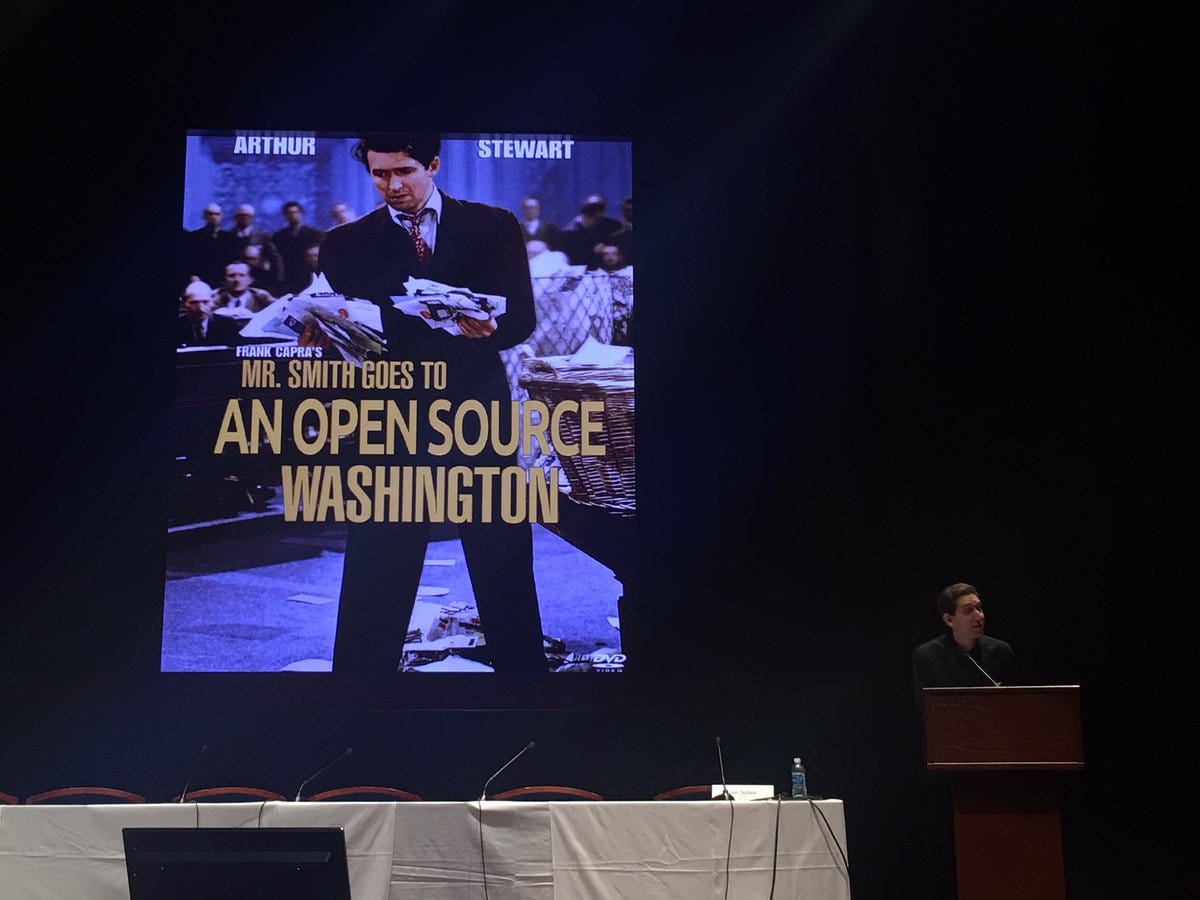
Josh Tauberer retelling Mr. Smith Goes To Washington. Photo Credit: Alex Howard.

I don’t want to get too deep into everything else for the sake of brevity. However, I do want to briefly mention:

  • The presentations on the use of mapping (GIS) data, particularly a fascinating presentation by CRS on the different kinds of maps they can generate for congressional staff. Additionally, it’s worth noting how Rep. Takano’s office uses maps to keep track of communications from constituents. The Senate’s GIS working group is of particular interest to anyone who wants to use geographic data to understand policy issues.
  • A great discussion on “consuming the law” which delved deep into when/whether it is possible for leg support offices to move towards focusing on electronic/online publication and moving away from print.
  • There’s much more, including great panels on five hacks for congress, the unfinished (digitization) work of congress, Josh’s excellent Mr. Smith presentation, UK and New Zealand digitization efforts, and the future of legislative publishing.

If you want still more, here are recaps of prior Legislative Data and Transparency Conferences:

2016 Legislative Data and Transparency Conference is this Tuesday, June 21

The House’s Legislative Data and Transparency Conference is this Tuesday, June 21, from 9-4, in the Capitol Visitor Center auditorium in Washington, DC. RSVP here.

The conference brings together individuals from Legislative Branch agencies with data users and transparency advocates to foster a conversation about the use of legislative data – addressing how agencies use technology well and how they can use it better in the future. This is the 5th annual conference, and the conversations that take place help change the nature of government.

House Speaker Paul Ryan and and the UK’s Director of Parliamentary Digital Service Rob Greig will both address the conference. Continue reading

House of Reps’ Spending Info Is Now Online as Data

Yesterday the House of Representatives began publishing its spending data online as a spreadsheet (and continued publishing it online as a PDF file).

As Josh Tauberer explains in Open Government Data: The Book, the compilation of spending data, known as the Statements of Disbursements, includes “how much congressmen and their staffs are paid, what kinds of expenses they have, and who they are paying for those services.” While it does not contain all the nitty-gritty details, the Disbursements data can tell you a lot about the health and activities of Congress.

Yesterday’s publication includes the full dataset for the first quarter of 2016 in a 17.8 MB CSV file, and a smaller 502 KB summary file in CSV format. The information is also published as a PDF, which it has been since November 2009. Continue reading

Data Coalition Celebrates New Open Data Law on Capitol Hill

On Wednesday, the Data Coalition hosted a Legislative Data Demo Day to show what’s possible when we make our laws and legislation more accessible.

Across all of our policy initiatives, the Data Coalition encourages federal and state governments to create or collect data in machine-readable structures using non-proprietary formats. This past Wednesday we explored how legal and regulatory information can be reformed in order to provide maximum value to both lawmakers, and the public. Continue reading

Next Steps in Congressional Openness: News from the May Bulk Data Task Force Meeting

The 21 year-old legislative information website THOMAS will be retired on July 5 was the top news from last Wednesday’s congressional Bulk Access to Legislative Data public meeting. The fact that THOMAS was shutting down was not news, but the timing was.

While it didn’t generate a story in the press, two other developments are particularly important regarding how Congress engages the public. For the first time, the meeting was webcast and panelists—who came from offices and agencies throughout the legislative branch—responded to questions from people inside and outside the room. This will soon become regular practice; and video will shortly be available. Even more striking, Congress is responding to technical comments made on GitHub to the data it releases, creating an ongoing, real-time conversation about public access to legislative information with all the relevant stakeholders. This is a big deal.  Continue reading